 Peace Lutheran Church
2025 Sermons
Posts Tagged "Gospel"
Second Sunday after Pentecost
June 22, 2025
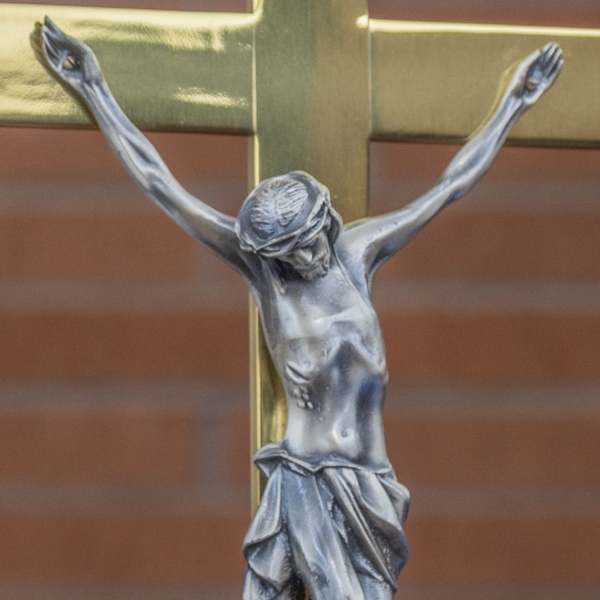
Text: Galatians 3:23–4:7
Outline:
1. Purpose of the Law
2. Purpose of the Seed
Sermon:
Grace, mercy, and peace be to you from God the Father and our Lord and Savior, Jesus Christ.
My dear beloved flock, the text for our meditation today is the Epistle Lesson of Saint Paul’s letter to the church in Galatia chapter three verse twenty-three through chapter four verse seven.
Boys and girls, I pray that you are doing well today. Have you ever had a guardian? Paul in our text for today talks about the Law as our guardian. A guardian is someone who watches over you in place of your mom and dad. It could be a grandparent or friend, possibly a babysitter when mom and dad go out for the evening. How is the Law of God like a guardian for us? Who is it replaced by? Ponder those questions as you hear the rest of the sermon. You may go back to your seats and those who love you.
1. Purpose of the Law
Have you ever been a slave? We might pause for a bit when we consider this question. Slavery in our modern context brings to mind images of whips, chains, harshness, anger, and, racism. Yet, that is Paul’s very question. We may not like to admit it, but we are all salves to someone. Either we are slaves to the world, under the condemnation and harshness of the Law of God, or we are slaves to Christ, freed by His death and resurrection from the curse of the Law? Which are you slaves to?
Before Christ and faith in Him came, the answer is clear. “Now before faith came, we were held captive under the law, qimprisoned until the coming faith would be revealed. So then, rthe law was our sguardian until Christ came, tin order that we might be justified by faith.” Our sinful nature is one in slavery to sin, death, and the power of the devil. It is bound in hellish chains to the elementary spirits of the world. Bound so tightly as to be impossible to free oneself. As we confess every Sunday, “We are sinners in thoughts, word, and deed, and we cannot save ourselves from our sinful condition.”
Because of our sins, we are worse that slaves, we are in prison in the deep, dark, depths, in chains forever. We are under the harsh accusations of the Law of God. The Law of God was given to Israel on Mount Saini. They were given 613 various commandments, everything from not mixing fibers of clothing, avoiding certain foods while preferring others, not touching dead people or animals, and much more. Every single one of these Laws stand in accusation against Israel, and us, God demands perfection. His Law shows how much we fail to be perfect.
Yet, if you were to ask someone today, they were probably say that they are pretty good. They have not done any major sins. They have not murdered anyone in action, they have not stolen much. They have been pretty good in terms of keeping their wife or husband happy. They have done good, certainly in comparison to other horrible people. That’s what the majority of people think. They think that they are pretty good, and certainly pretty good is enough to get you into heaven. You just have to do better. They say things like, “Jesus is great, but you need to join our church and stop drinking coffee and wear certain kinds of underwear; and don’t smoke, and don’t chew, and don’t hang out with those that do, and you can go to heaven.” God will settle for pretty good if you are one of us. They forget that we have broken God’s law. The wages of sin is death. We’re all under the condemnation and judgment of the Law.
1. Purpose of the Seed
Yet the Law is good. The Law accuses that we would be prepared to hear the sweet words of the Gospel. We might consider the actions of the Law the same as a thermometer. When you take your temperature with a thermometer, you find out you need to take something to treat the fever that you might have. Now, a thermometer, or something that takes your temperature, isn’t going to take your temperature down. You can walk around with a thermometer in your mouth all day, and it’s not going to do anything. If you realize you’re running a fever, then you have to take the proper medicine to lower the fever. The law is like a thermometer. It shows you your sin. It drives you to Jesus, the medicine that we need to remedy the malady or the sickness or the disease that we have, which, in this case, is our sin so that we might be justified by faith.
The Law was only established for a short time, as a guardian for us. In ancient Roman culture, a “guardian” was someone who was employed by a wealthy family and who had the responsibility of supervising a young boy of the family until that boy became a man. This “guardian” would make sure the boy received a proper education and learned the skills that would be necessary for him to be successful as an adult. And the guardian would also be in charge of disciplining the boy in whatever ways the guardian thought necessary in order to ensure the boy’s character development. So, the guardian would have authority over just about every aspect of the boy’s life. However, once that boy reached a certain age, he would be free from the authority of his guardian. The guardian’s assignment would then be complete since the boy formerly under his supervision would have become a man. So Paul says that the Law was temporary until a certain time.
That time? When Christ came. “4 But dwhen the fullness of time had come, God sent forth his Son, eborn fof woman, born gunder the law, 5 hto redeem those who were under the law, so that we might receive iadoption as sons. 6 And because you are sons, God has sent jthe Spirit of his Son into our hearts, crying, “Abba! Father!” 7 So you are no longer a slave, but a son, and if a son, then kan heir through God.” When the time was right, the Father sends the Son, our Lord and Savior, Jesus Christ, born of the Virgin Mary. Jesus was born under the Law. He took on flesh, why? To redeem us. To buy us back. Through His perfect life, Jesus fulfills all of the Law on our behalf. Jesus takes all our sins, all the Law’s condemnation, upon His Holy Flesh as He hangs, accursed on the tree. Shedding His blood and rising again from the dead, Jesus breaks us out of our slavery, breaks the chains that bind us, and brings us out of the darkness of the prison, into His marvelous light, that we might receive adoption as Sons. Adoption in our modern world is an incredibly long process that involves mountains of paperwork, numerous interviews, and a whole lot of waiting. It’s also surprisingly expensive. The average cost of an international adoption is between 20 and 50 thousand dollars. So, needless to say, if you desire to adopt a child, you had better be prepared for that. It takes a lot to see that process through to completion.
That is what God has done for us in Christ. This fact should confound our minds. We, who were enemies of God, under His condemnation and punishment because of our sins. Yet now, in and through Jesus Christ, the God-man, we can cry “Abba! Father!” And He will hear and answer us as His dear and beloved children. It does not matter who you are, or what you have done. Paul says, “you are all sons of God.” Every Christian has equal standing before God and equal status as a “son” of God. Even the Christian who’s the lowliest in the eyes many in this world has just as much standing and status in the eyes of God as any other Christian.
How does this happen? In the waters of Holy Baptism. There, you are clothed with Christ. Jesus is as close to you as your own clothing is today. Clothed with Christ, your sins are washed away by His blood. You are cleansed, connected with Jesus. You come dead in your sins and trespasses, your old Adam, your sinful nature is crucified with Christ. It drowns and dies. Yet, you rise to newness of life forever in Christ, a son of the eternal Father.
A key feature of our sonship is that we’re heirs of an eternal inheritance that’s greater than we can ever imagine. And the first installment of that inheritance is God himself—in the Person of the Holy Spirit—actually living within us. I mean, think about it: there’s no greater gift God could ever give than the gift of himself, and that’s exactly what he does in sending the Holy Spirit to dwell within our hearts. It’s kind of like we now have God’s DNA. Of course, in a regular adoption, the adopted child never actually has the DNA of the adoptive parents. But when God adopts us into his family, there’s a certain sense in which he’s actually able to give us his DNA through the Holy Spirit, who comes into our hearts and progressively changes us, from the inside out, to be more like God.
Thanks be to God, that He has saved us. He has justified us in faith that clings to Jesus Christ, His death and resurrection, until that day when our inheritance has been fully realized, and we are with our beloved Heavenly Father, the Son, and the Holy Spirit, with all our fellow brothers forever and ever.
The peace of God, which surpasses all understanding, guard, and keep, your hearts and minds in Christ Jesus. Amen.