 Peace Lutheran Church
Sixth Sunday of Easter
May 10, 2026
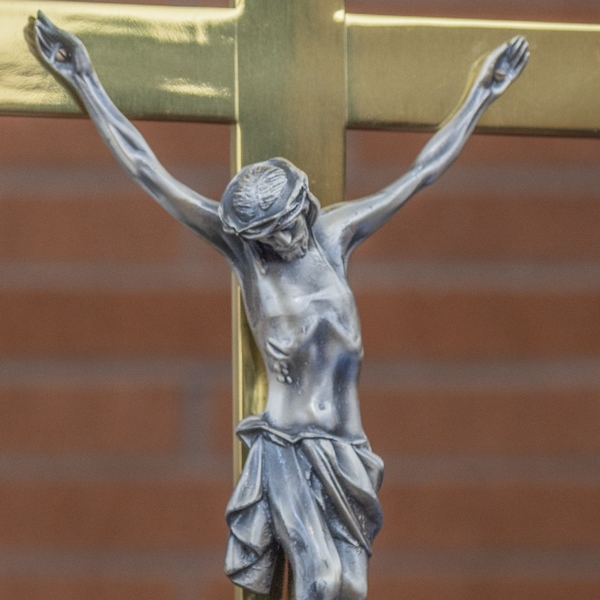
Text: Acts 17:16-31
Theme: An Old New Teaching
Outline
1. Paul in Athens
2. Old teaching: In God we live move and have our being.
3. New Teaching: Jesus and Resurrection, will judge world by One whom He has appointed.
Sermon
Alleluia! Christ is Risen!
He is Risen indeed! Alleluia!
Grace, mercy, and peace be to you from God our Father, and our Lord and Savior, Jesus Christ.
My dear beloved flock, the text for our meditation is the Acts of the Apostles, the seventeenth chapter verses sixteen through thirty-one.
Beloved Lambs, I pray that you are doing well today. Have you ever been surrounded? I know many of you are surrounded every night by al of the blankets, stuffies, and toys in your beds. We are often surrounded by friends and family at school and home. Here at church we are surrounded by all of the fellow believers in Jesus Christ around God’s Word and Sacraments. In our text for today, Saint Paul is surrounded. What is he surrounded by? How does he use his surroundings to tell about Jesus? Ponder those questions as you hear the rest of the sermon. You may go back to your seats and those who love you.
1. Paul in Athens
Our text begins, “Now while Paul was waiting for them at Athens ” Saint Paul is in the city of Athens, waiting for Silas and Timothy to join him from Berea. As Paul is in Athens for what is probably the first time, he plays tourist. He walks around Athens, conversing with the shop owners, talking with the passersby who will listen. He debates with the Epicurean and Stoic philosophers as they gather daily in the market places.
Athens is unlike any other city that Paul has been to. In the past, Athens taught the world the concept of democracy, the rule of the people. It had been the great center of philosophy, the love of wisdom. For its past contributions in politics, art, literature, and the world of ideas, the city was honored by the Roman Empire. But its glories had dimmed, and it was no longer the chief city of Greece. Those who live there still hold onto their intellectual past, even though Aristotle, Plato, Socrates, Sophocles, Euripides, Pericles, Demosthenes and Zeno had been dead for hundreds of years. The people loved nothing more than to constantly hear the worlds news, listen to new ideas, ponder, and debate everything.
As Paul is being a tourist, he is utterly appalled by what he sees. His spirit was παροξύνω parozuno, angered/provoked within him. Why was Paul’s spirit angry? On every single corner, he sees idols dedicated to a false god. The ancient writer Petronius said that in Athens it is easier to find a god than a man. The physician Pausanias said that Athens had more images than all of Greece put together. The historian philosopher Xenophon called Athens one great altar to the gods. Every god of Olympus had an altar or temple in the city. Many had entire buildings dedicated to their honor. Every public structure surrounding the Agora was in the name of one or more of the deities. There were the gods of fame, modesty, energy, persuasion, to name a few. Even a few to unknown gods. Six hundred years before Paul, a terrible plague came on the city and a man name Epimenides had an idea. He let loose a flock of sheep through the town, and wherever they lay down, they sacrificed that sheep to the god that had the nearest shrine or temple. If a sheep lay down near no shrine or temple, they sacrificed the sheep TO THE UNKNOWN GOD.
2. Old teaching
Paul uses this Altar to the unknown God to proclaim the glory of the true God. He is brought to Mars hill, where the supreme court of Athens used to meet. They want to know what in the world Paul is talking about with Jesus and the Resurrection. Some think he’s just a babbler, a seed picker picking up bits of wisdom from others and putting his own spin on things. Paul begins with the old teaching that is plain to everyone still today, even to those who do not believe. There is a God.
“Men of Athens, I perceive that in every way you are very religious. Paul praises the city for being religious and points out that they have a god for everything, even the gods that are unknown to them but known to others.
This is what we call natural knowledge of God as Creator. God has placed His fingerprints into the very fabric of creation. Just look at the natural world around us. The complexity of nature tells us that there is a god. The fact that trees produce oxygen and we exhale the carbon dioxide that they need is nothing short of a miracle. The complexity of our brains, ears, and eyes is so amazing that we cannot comprehend it. There is no way that everything can arise from random chance.
There must be a god, but whose god is the true god? The people of Athens are very religious, to their own destruction. They followed idols of their own creations, silver, wood, stone, and gold. They created and followed after gods of their own making, made of silver, gold, wood, and stone. These gods needed things from their worshipers. The people had to make a temple, a dwelling place. They had to provide food and drink for the god to eat. They had to do something to appease the god if they were angry at them for whatever sin they did. The Athenians constantly listened to and debated ideas so that they could best follow the gods that they had made.
Not much has changed, even after all these years. We still break the first commandment, creating and following gods of our own making. Our sinful nature wants a god that we can comprehend. We want a god that we can understand fully, one who acts like us, thinks like us, behaves like us. One that we can appease if things do not go rightly.
One of the ways that we try to understand and control god is through our intellect. We hunger and discuss every scrap of news that we can get ahold of, whether good or bad. We constantly have the 24/7 news station of our choosing constantly going. We get notification after notification on our phones for this or that breaking news story. We hear one news story, discuss it and dissect it from multiple angles, then the next day it is old news, another has replaced it and the cycle continues again. We use this knowledge and discuss to shape our worldview of both ourselves and of God.
Rather than pondering over the Word of God, reading, marking, learning, and inwardly digesting the very Words that He has graciously given to us, we digest the news and things of this world. We make our own gods of ourselves, our wants, needs, and desires. We follow after gods who cannot speak, hear, or act, because we want our own pleasures fulfilled rather than following the true God. Truly, we are just as religious as the Athenians were, a god on every corner, to our own eternal destruction.
3. New Teaching
Paul give them a new teaching. That which they had known as an unknown god, Paul proclaim as known. He states 24 The God who made the world and everything in it, being Lord of heaven and earth, does not live in temples made by man, 25 nor is he served by human hands, as though he needed anything, since he himself gives to all mankind life and breath and everything. ” we ought not to think that the divine being is like gold or silver or stone, an image formed by the art and imagination of man
The true God of creation is not one that needs humanity to serve Him. He is not one formed by our own hands of silver and gold. He is not a god of our own creation, of our own minds. He does not always act how we think he should act. God controls everything. He does not need our food and drink to so that he can eat. He is not one that can be appeased by our works, for indeed our best works are as dirty filthy rags. Rather, the true God is outside of our comprehension, outside of time and space itself as the ultimate Creator of heaven and Earth.
Yet, God is not distant. God is not an aloof Creator, merely starting creation then letting happen whatever happens. In grace and mercy, God has made Himself known. How has He done this? Not only through Creation but also in and through His Son, Jesus Christ. He is the glory of God made flesh. As Jesus says in John, “He who has seen me has seen the Father.” God has entered into His creation to serve and save us. Jesus took on flesh in the womb of the blessed virgin Mary to save us from our sins, death, and the devil. To give to us everlasting life through His death and resurrection from the dead.
Because Jesus died, we know that our sins are forgiven. He has borne the sins of everyone across all of time and space. He died our death in our place. He shed His blood so that we do not have to shed ours. We know that His sacrifice upon the cross was acceptable in the eyes of God the Father because Jesus did not stay dead. He rose from the dead on the third day. That is the Father’s Amen to our Lord’s cry of Telestestai “It is finished.”
The God who created everything seen and unseen, loves you so much that He dies and rises again from the dead to forgive you. God dies, God bleeds, for you. His love is constantly shown for you in His Word and Sacrament. In the waters of Holy Baptism, you are united to Him and made a beloved child of God Himself. He calls you His offspring, His Sons because of His eternally Beloved Son.
A beloved Son whom We will see face to face. Jesus died and rose, and He will come again. As Paul says, “he will judge the world in righteousness by a man whom he has appointed; and of this he has given assurance to all by raising him from the dead.” Jesus has won the right, as the One who has redeemed humanity, to judge the living and the dead at the end of time itself. Jesus will come again. He will raise the dead, judge the world in righreiousness, and we will live with Him in a world without end.
Alleluia! Christ is Risen!
He is Risen Indeed! Alleluia!
The Peace of God, which surpasses all understanding, guard, and keep, your hearts and minds in Christ Jesus. Amen.